
High Wind Edge Metal Repair in Lexington, KY from Commercial Roofing of Lexington.
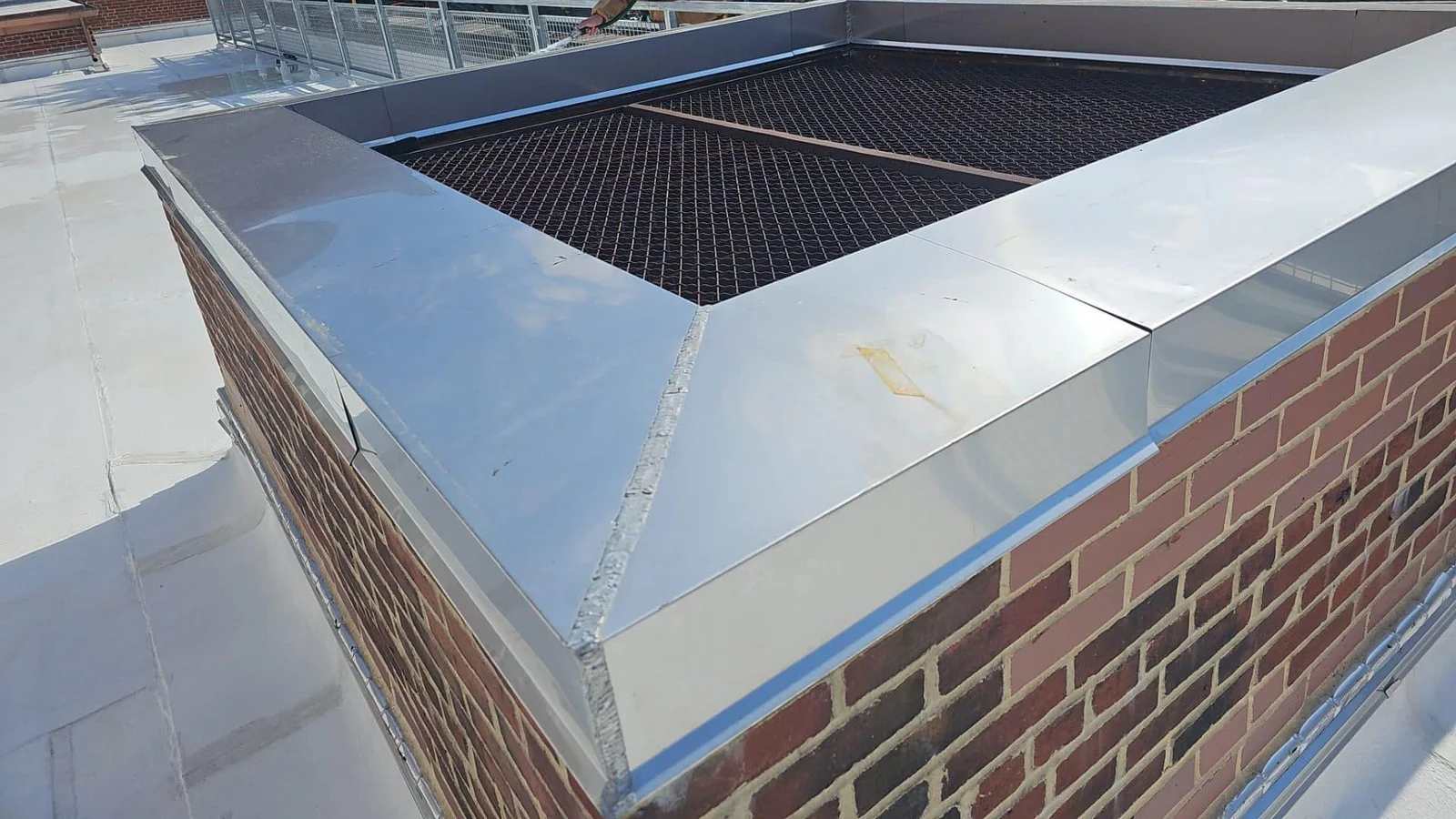
The Roof Edge Is Where Wind Damage Begins
When a storm tears a commercial roof apart in Lexington, the failure rarely starts in the middle of the field. It starts at the perimeter. Wind moving over a low-slope roof accelerates as it passes the edge and generates a zone of intense suction right at the corners and along the parapet line. If the edge metal or coping that caps that perimeter is not anchored to resist that uplift, the wind gets a grip under the lip, peels the metal back, and from there it has the membrane edge exposed and can roll the field membrane off the deck. We have walked plenty of post-storm roofs across Fayette County where the entire loss traced back to a few feet of edge metal that let go first. Secure the edge and the rest of the roof usually stays put. Lose the edge and you lose the roof.
What ES-1 Securement Means and Why It Matters
There is a standard written specifically for this problem. ANSI/SPRI ES-1 is the test and design standard for the perimeter edge of low-slope roofs , the fascia, drip edge, gutters, and coping that finish the roof at the wall. It exists because edge-metal blow-off was such a common and damaging failure mode that the industry built a dedicated standard around resisting it, and modern building codes reference it for commercial roofs. ES-1 governs how the metal is fabricated, how the continuous cleat or anchor bar is sized, and how tightly the fasteners are spaced so the assembly can take the design wind uplift for the building. A lot of the failed edges we repair were never built to that standard in the first place , face-nailed metal, undersized or missing cleats, fasteners spaced too far apart. When we re-detail an edge, ES-1 is the target, so the repair is genuinely stronger than what blew off.
How Edge Metal and Coping Actually Fail
Edge failures follow a few recognizable patterns. The most common is a continuous cleat that was never installed or was undersized, so the only thing holding the metal down is the exposed face fasteners , and those work loose over years of thermal cycling until a strong gust finishes the job. We also see coping caps on parapet walls where the splice joints were never properly cleated or sealed, so wind pries the joints apart and drives rain into the wall assembly. Fastener corrosion is another: in an older edge the screws rust and lose their grip in the substrate. And thermal movement plays a constant role, because a long run of metal expands and contracts every day and an edge that was not detailed to move will fatigue its own fasteners loose. By the time we are called, the visible damage is often just the section that let go first, with the adjacent runs already loosened and ready to follow.
Lexington Weather and the Perimeter
Central Kentucky does not get hurricanes, but it gets the severe convective storms that march across the Bluegrass through spring and summer, and the straight-line winds and downbursts inside those storm lines are exactly what find a weak roof edge. A microburst can put a brief, violent uplift load on a perimeter that has been quietly loosening for years, and that is the gust that takes the metal. On top of that, Lexington's freeze-thaw winters , with their repeated cycles above and below freezing , work edge fasteners loose over time and drive moisture into any open splice joint, so by the time the windy season arrives the edge is already compromised. We see the worst edge failures on exposed buildings: the standalone retail boxes and the large warehouse and distribution roofs out by the I-64/I-75 interchange, where there is nothing upwind to break the flow before it hits the parapet.
Re-Anchoring After a Wind Event
After the wind has already done its damage, the repair is more than screwing the old metal back down. We start by figuring out how far the failure actually runs, because the displaced section is usually not the whole problem , the runs on either side have typically lost their grip too, and putting back only the obvious piece leaves the next-weakest length to fail in the following storm. Then we re-detail the edge properly: a continuous cleat sized for the building's wind zone, new fabricated metal where the old is bent or torn, fastener type and spacing brought up to ES-1, and the membrane edge re-stripped and sealed back into the new metal so water cannot track behind it. Where coping is involved, the splice joints get proper cleats and cover plates so the joints move without opening. The goal is an edge that is engineered to hold, not one that is patched back to the condition that just failed.
Emergency Response and Documentation
A failed roof edge is often an active emergency, because once the perimeter opens, water gets behind the metal and into the wall and the field membrane is exposed to the next round of wind. We can dry the roof in and stabilize the open edge quickly to stop the bleeding, then come back for the permanent ES-1 repair once the weather allows and the scope is fully understood. Because edge failures usually run through an insurance claim, we document carefully , where the failure started, how far it ran, the condition of the cleat and fasteners we found, and photographs tied to roof locations. We report what we observe as a roofing contractor and give your adjuster the evidence to evaluate the claim; we do not act as a public adjuster or promise a particular outcome. What you get from us is a perimeter that is genuinely re-secured and a record clear enough to defend the repair.
Questions Owners Ask
Why did only the edge of my roof blow off and not the middle?
Because that is where the wind load is highest. Air accelerating over the roof edge creates intense suction at the corners and along the parapet, and if the edge metal or coping is not anchored to resist it, the wind gets under the lip and peels it back. Once the edge is gone the field membrane is exposed and can roll off too. The edge is the failure that starts the others.
What is ANSI/SPRI ES-1 and does my repair need to meet it?
ES-1 is the industry standard for the perimeter edge of low-slope roofs , how the fascia, drip edge, and coping are fabricated and anchored to resist wind uplift. Modern codes reference it for commercial roofs, and many edges that fail were never built to it. When we re-detail a failed edge we build to ES-1, so the repair resists more uplift than the metal that blew off.
Can you just reattach the metal that came loose?
That is the patch that fails again. The displaced section is rarely the whole problem , the runs beside it have usually lost their grip too. We determine how far the failure really extends, install a continuous cleat sized for your wind zone, bring fastener type and spacing up to ES-1, and re-strip the membrane edge into the new metal so the perimeter is engineered to hold rather than restored to the condition that just failed.
Does Lexington really get wind strong enough to cause this?
Yes. We do not get hurricanes, but the severe storm lines that cross central Kentucky in spring and summer carry straight-line winds and downbursts, and a microburst can put a brief, violent uplift load on a perimeter that has been loosening for years. Add freeze-thaw winters working the fasteners loose, and exposed retail and warehouse roofs out by the interstates are especially vulnerable.
My roof edge just failed in a storm , can you respond now?
Yes. A failed edge is usually an active emergency because water gets behind the metal and into the wall and the field membrane is exposed. We can dry the roof in and stabilize the open edge quickly to stop further damage, then return for the permanent ES-1 repair once the full scope is clear. We document the failure thoroughly for your insurance claim while we are there.