
Spray Foam Roofing in Lexington, KY from Commercial Roofing of Lexington.
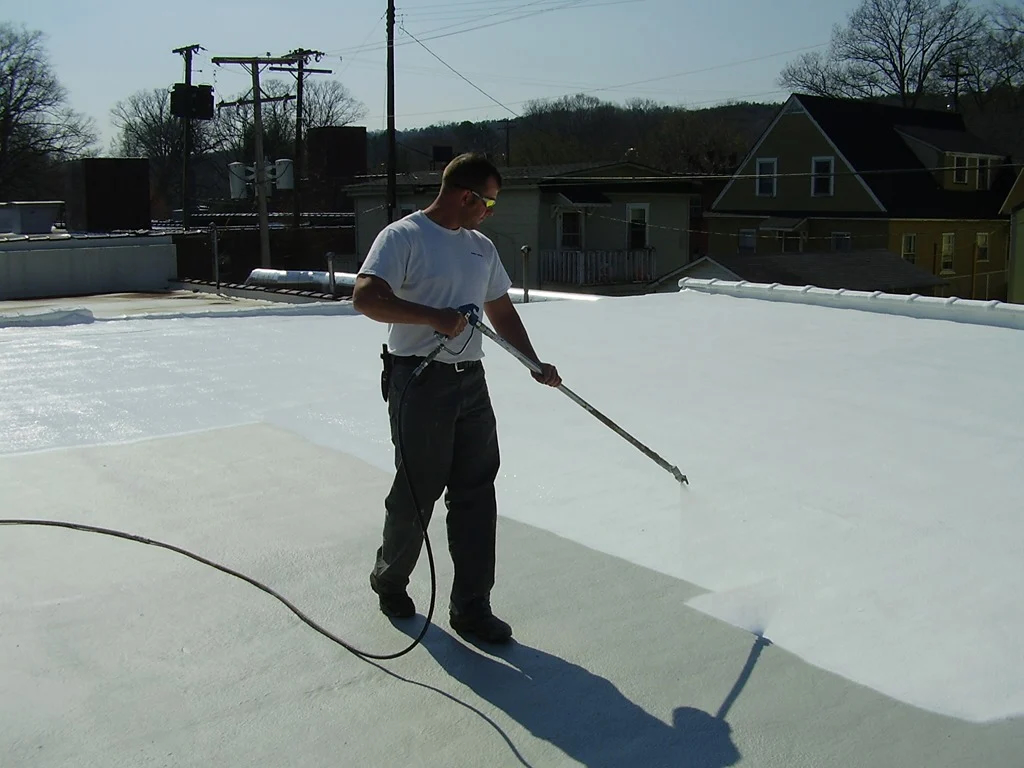
Spray polyurethane foam roofing occupies a niche in Lexington's commercial market that is genuinely well-suited to specific building types , and genuinely wrong for others. The buildings where SPF performs best are metal buildings with irregular geometry, penetration-heavy surfaces, and poor existing insulation: exactly the profile of many auto-supplier facilities and light-manufacturing buildings at Legacy Business Park, along the Georgetown Road industrial corridor, and at the outer parcels of Bluegrass Station. Understanding why SPF is the right answer for these buildings , and being honest about where it isn't , is the starting point for a useful conversation about whether foam is appropriate for a specific Lexington commercial property.
The fundamental advantage of spray foam on a metal building is conformity. A two-component polyurethane foam system is sprayed as a liquid that expands and adheres to the existing roof surface, filling every valley, seaming over every fastener head, bridging every panel rib, and encapsulating every penetration in a continuous monolithic layer. The resulting surface has no seams, no laps, no fastener penetrations , the failure modes that define the maintenance liabilities of conventional metal roofing systems are eliminated. On a Legacy Business Park building with 15,000 exposed fasteners in a 40-year-old R-panel roof where half the fastener washers are hardened or missing, SPF converts that high-maintenance surface into a seamless substrate in a single mobilization.
The insulation value of spray foam is its second major advantage for Lexington's industrial building stock. A 2-inch SPF application delivers approximately R-12 to R-14 of continuous insulation with no thermal bridging at fasteners or seams , the thermal bridge paths that compromise the effective R-value of a mechanically fastened insulation system over a metal deck are eliminated when the foam is sprayed continuously over the entire surface. Auto-supplier facilities along the Georgetown Road and Newtown Pike corridors that were built with minimal roof insulation in the 1980s and 1990s can realize substantial heating and cooling savings from an SPF installation that adds meaningful thermal resistance while simultaneously addressing the waterproofing failures of the aged original roof system.
Irregular roofline geometry , the skylights, ventilator curbs, lean-to additions, equipment platforms, and access hatches that accumulate on industrial metal buildings over decades of operational modifications , is where SPF proves its adaptability. A conventional single-ply membrane system on a building with 40 penetrations, five irregular roofline changes, and three different roof pitches requires extensive custom flashing fabrication at each transition point. SPF is sprayed around, over, and through all of those conditions continuously, with the foam self-flashing at every transition and the elastomeric topcoat creating a uniform surface from ridge to eave. This adaptability makes SPF the practical specification choice for metal buildings that would require very high labor-cost custom flashing work under a conventional membrane approach.
The topcoat on a spray foam roofing system is not optional , it is a structural component of the assembly. Uncoated polyurethane foam degrades rapidly under UV exposure, losing surface integrity within weeks of installation without a protective coating. The topcoat , typically a silicone or polyurethane elastomeric coating , protects the foam from UV and provides the weather resistance of the final system. It also determines the color of the finished roof: a white silicone topcoat on a Lexington industrial building that previously had a dark metal roof can reduce rooftop surface temperature by 50 to 70 degrees on a summer day, with corresponding reductions in building cooling load. The topcoat is also the component that requires periodic maintenance: a properly applied recoat on the schedule specified by the manufacturer , typically every 10 to 15 years , extends the foam system's service life indefinitely without requiring tear-off or replacement of the foam substrate.
Substrate preparation for SPF installation is the variable that most significantly affects long-term performance. Metal panel surfaces must be clean, dry, and free of loose paint, surface rust, grease, and oil contamination before foam adhesion will be adequate. We conduct a systematic pre-installation surface assessment on every SPF project, pressure washing and treating areas with contamination, wire-brushing loose paint and surface rust, and ensuring the substrate temperature is above the minimum application temperature for the specific foam formulation. Foam applied to a contaminated or cold substrate may achieve apparent adhesion initially but will delaminate from the substrate within a few seasons, taking the investment with it.
SPF on Lexington commercial buildings has a wind uplift design requirement that needs specific engineering attention on larger buildings. The foam-to-substrate adhesion provides the primary wind uplift resistance on SPF systems, and the design uplift pressures vary significantly across a roof , the perimeter and corners of a metal building in an open exposure situation see substantially higher uplift forces than the field of the roof. SPFA and manufacturer technical guidelines address uplift design, and we apply the appropriate foam density and thickness at perimeter zones rather than applying a uniform specification across the full roof area.
Moisture management is the condition that disqualifies SPF for certain Lexington commercial buildings. Spray foam cannot be applied over wet insulation or a wet substrate , the foam will not properly adhere, and any moisture trapped beneath the foam will cause delamination as the building cycles thermally. On buildings with confirmed wet insulation , identified by infrared scan and core sampling , the wet sections must be replaced before SPF is applied. For metal buildings where the existing insulation has been saturated by years of fastener leaks, this can mean a significant remediation scope before foam installation can begin. We assess insulation moisture content as a standard pre-project step on all SPF candidates.
For building owners evaluating SPF on Lexington commercial buildings, the long-term maintenance cost argument is compelling relative to conventional membrane systems. An SPF system on a metal building eliminates fastener maintenance entirely, provides a recoatable surface that extends system life on a defined cycle without tear-off, and delivers superior insulation value with no thermal bridging. The higher initial installed cost relative to a conventional membrane recover , and SPF does cost more per square foot than a standard recover , should be evaluated against the 10- to 15-year maintenance cost savings and the improved thermal performance over the building's remaining ownership horizon.
Questions Owners Ask
Is spray foam roofing durable enough for Lexington's climate?
Yes, when properly specified and applied with an appropriate elastomeric topcoat. SPF has been installed successfully in climates with more demanding freeze-thaw cycling than Lexington's, and in markets with higher UV intensity. The key performance variables are foam density (we specify 3-pound closed-cell density for roofing applications), topcoat type and thickness, and substrate preparation quality. The system's maintenance requirement , periodic topcoat reapplication , is straightforward and less expensive than most conventional roofing maintenance programs.
How long does spray foam roofing last?
A properly installed SPF system with timely topcoat maintenance can perform indefinitely , the foam substrate doesn't have a defined end of service life in the way that membrane systems do. The topcoat is the consumable component, typically recoated every 10 to 15 years depending on the coating type and the specific exposure conditions. Each recoat cycle extends the system life without requiring foam removal or substrate replacement, making SPF one of the most cost-effective long-term roofing solutions for the buildings it suits.
Can spray foam be applied over an existing metal roof?
Yes, provided the substrate is dry, structurally sound, and properly prepared. We assess panel condition, confirm insulation dryness with infrared and core sampling, and complete surface preparation before application. Panels with through-corrosion need replacement before foam is applied , foam over a perforated panel will adhere to the foam side of the perforation but leave the opening below unaddressed. Panels with surface oxidation but intact structure are treated and primed as part of preparation.
What does the recoating maintenance process involve?
Recoating involves surface cleaning and inspection of the existing foam and topcoat, repair of any areas where the foam has been physically damaged or the topcoat has failed, primer application where needed, and application of a new topcoat layer at the specified wet mil thickness. The process is significantly less disruptive and less expensive than a conventional membrane replacement , no tear-off, no disposal, no structural impact. We schedule recoat visits and flag buildings in our maintenance portfolio that are approaching their recoat window.
What building types are NOT good candidates for spray foam?
Buildings with confirmed wet insulation that would require extensive remediation before foam application, buildings with structural deck conditions that make foam adhesion unreliable, and buildings in applications requiring a traffic-rated surface (pedestrian decks or vehicular surfaces) where SPF's puncture resistance under foot or vehicle traffic is inadequate without specific protective overburden. For standard flat-roof commercial buildings with single-ply or modified bitumen systems in good condition, a conventional recover is typically more cost-effective than SPF. SPF earns its economics on metal buildings with high penetration density and poor existing insulation.