
Standing Seam Metal Roofing in Lexington, KY from Commercial Roofing of Lexington.
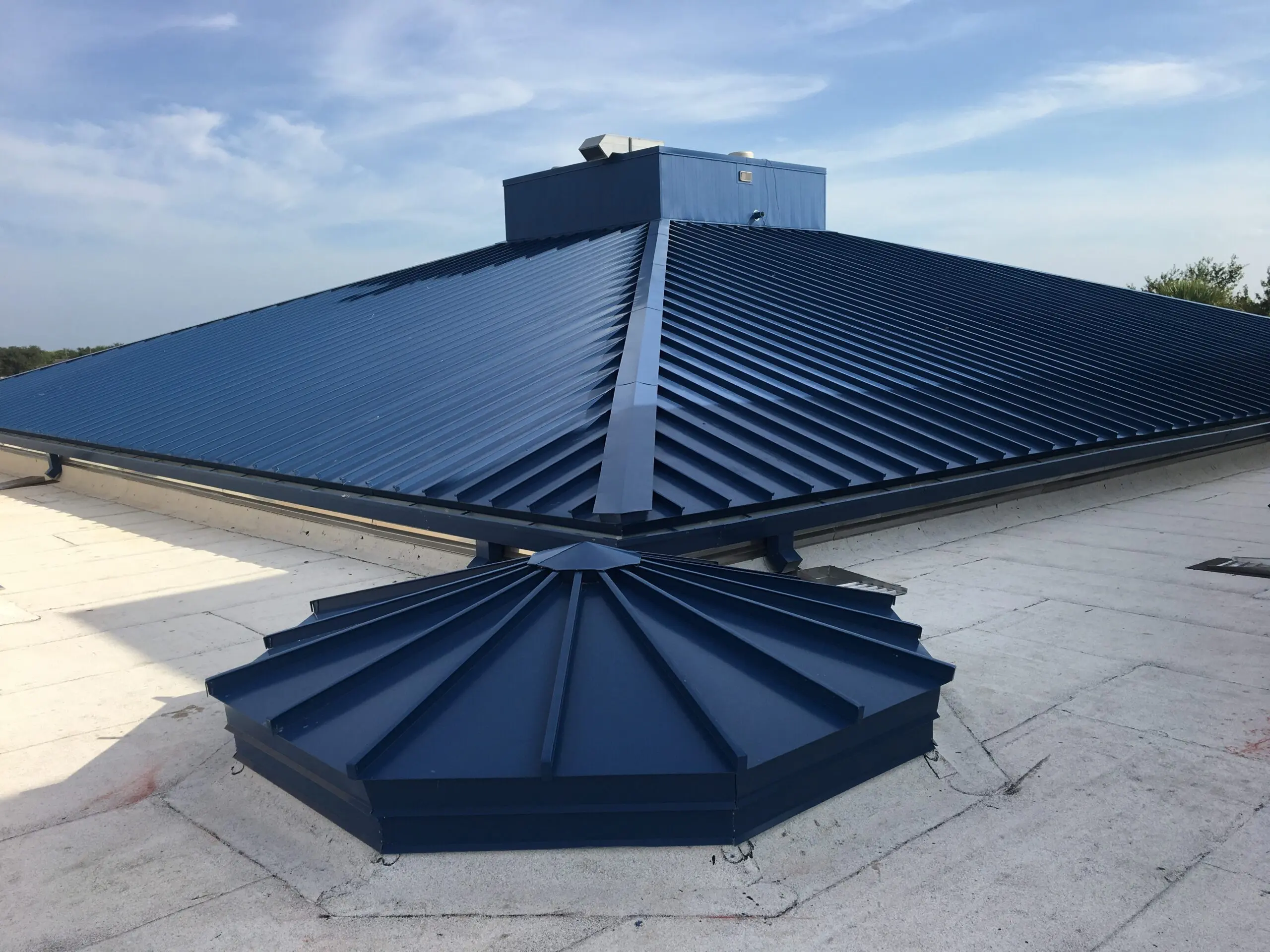
Standing seam metal roofing is the premium specification in commercial metal roofing, and its adoption in Lexington's commercial market has accelerated as building owners and architects have recognized the lifecycle cost advantages over exposed-fastener systems. The defining characteristic is the concealed fastener: attachment clips hidden beneath the raised seam allow the panel to move freely with thermal expansion and contraction without stressing the panel or the attachment. On a Coldstream Research Campus corporate headquarters building, a Toyota supplier facility on Georgetown Road, or a medical office on the UK campus perimeter, standing seam delivers a roof that performs for 40-plus years with minimal maintenance intervention , a meaningfully different ownership proposition than the fastener-replacement cycle that exposed-fastener R-panel requires.
Thermal movement engineering is the design discipline that distinguishes a properly engineered standing seam installation from one that will show oil-canning, panel distortion, and clip stress within five years. Lexington's climate imposes a substantial thermal range on metal roofing: a standing seam panel running 50 feet up a south-facing Coldstream Research Campus building face moves approximately 5/8 inch between its January cold temperature and its July peak temperature. That movement is accommodated by the floating clip, which allows the panel to slide through the clip assembly rather than being fixed at each fastener point. Engineering the clip pattern, clip type, and thermal anchor locations correctly for the specific panel length, metal gauge, and building geometry is not a rule-of-thumb exercise , it's a calculation that depends on the coefficient of thermal expansion of the specific panel material and the temperature range of the installation site.
Standing seam is available in steel, aluminum, and copper, each with different weight, corrosion resistance, thermal movement coefficients, and cost profiles. Steel standing seam , typically Galvalume-coated steel in 24-gauge for commercial applications , is the standard specification for industrial and corporate campus buildings in Lexington. Aluminum standing seam has a higher thermal expansion coefficient than steel, which requires more generous clip design for a given panel length, but it offers superior corrosion resistance for buildings in high-moisture or chemical exposure environments. Copper standing seam is reserved for landmark or prestige applications , certain historic renovations downtown and institutional buildings where the patina character is part of the design intent , because its cost is several multiples of steel.
The Toyota supplier network along Georgetown Road and Newtown Pike includes buildings where standing seam has become the standard specification for new construction and major re-roofing. Japanese-influenced manufacturing facility design often places high value on building envelope quality and long-term maintenance minimization, and standing seam aligns with that philosophy. These facilities also have operational reasons to minimize roof maintenance interruptions , a production facility that needs to shut down a line to accommodate rooftop work on a fastener maintenance cycle has a tangible cost argument for the higher upfront investment in concealed-fastener standing seam.
Coldstream Research Campus buildings with standing seam have a specific specification requirement that standard industrial buildings don't: the panel system must accommodate rooftop equipment access routes without panel damage. Research buildings generate frequent rooftop equipment service requirements , HVAC technicians, lab ventilation maintenance, telecommunications infrastructure upgrades , and the standing seam panel rib is a trip hazard and a potential damage point if the access routes aren't managed. We specify walkway pads at all designated service routes on Coldstream buildings and coordinate their placement with the building's facilities management team before installation is complete. A walkway pad that protects the panel surface at a high-traffic service route is a minor addition to the project scope; a dented or distorted panel from unprotected foot traffic is a warranty claim and a building envelope compromise.
Sidelap and endlap sealant in standing seam systems , the sealant applied in the seam at panel side joints and at end conditions , is a critical long-term performance component that receives insufficient attention during installation quality control. The sealant must be applied continuously without voids, at the correct location within the seam, and using a product that remains flexible through Lexington's thermal cycling range. Butyl sealant is the industry standard for standing seam applications because it maintains flexibility at low temperatures and doesn't harden and crack under freeze-thaw cycling the way polyurethane-based products can. We inspect sealant application quality during installation on standing seam projects because a voided seam sealant section discovered during a leak diagnosis five years after installation is an expensive problem to access and correct.
Valley and hip conditions on standing seam roofs with non-standard geometry , the architectural complexity that appears on corporate campus buildings, medical facility additions, and institutional construction throughout Lexington , require custom pan fabrication and careful field execution. A valley on a standing seam roof must accommodate the panel seams from two converging slopes while maintaining the weather-tightness of the valley itself, typically achieved through a formed valley pan that runs beneath the panel ends. Getting this detail right requires a fabrication capability and field experience that separates specialty standing seam contractors from general commercial roofers who have added the product to their offering. We maintain the fabrication and installation capacity to execute custom geometry standing seam work correctly, not just the standard straight-run field panel installation.
Gutter and fascia integration on standing seam buildings is a design and installation detail that affects both the aesthetics and the waterproofing performance of the building envelope at the eave. A properly integrated continuous cleat at the eave connects the panel system to the gutter assembly in a way that manages thermal movement at the eave , the panel must be free to move relative to the gutter without creating stress at the connection. Gutters on standing seam buildings should be sized for the contributing roof area and the Lexington design storm intensity, not sized for the fascia profile. We size gutter systems correctly from the hydraulic design basis on every standing seam project, not from visual proportion alone.
Long-term standing seam maintenance in Lexington is primarily attention to the trim conditions , ridge cap, eave trim, rake trim, and any penetration flashings , rather than the panel field. The panel system itself, properly installed with correct clip design and sealant, requires no routine maintenance beyond inspection. The trim conditions are where age-related sealant failure and fastener back-out occur, and addressing these as routine maintenance items , re-bedding exposed fasteners in trim, refreshing sealant at trim laps , prevents water entry at the perimeter and penetration locations while the panel field continues to perform without intervention.
Questions Owners Ask
What's the difference between standing seam and R-panel for a commercial building?
R-panel uses exposed fasteners through the panel face into the structural support , each screw head is a potential leak point and a maintenance obligation as the neoprene washer ages. Standing seam uses concealed clips beneath the raised seam, with no exposed fasteners in the panel field. Standing seam accommodates thermal movement through the floating clip; R-panel fixes the panel at each fastener location, which causes distortion over time. Standing seam costs more initially but has substantially lower 20-year maintenance cost.
How long does standing seam metal roofing last?
A properly installed Galvalume steel standing seam system with a high-performance PVDF paint finish has a design life of 40 to 60 years in central Kentucky's climate. Aluminum standing seam has similar longevity with better corrosion resistance in humid or chemical exposure environments. The primary maintenance items over that service life are trim condition and sealant maintenance , the panel field itself typically performs for the full design life without replacement.
Can standing seam be installed over an existing metal roof?
Yes, using a subframing system that raises the new standing seam panels above the existing roof surface. This approach , called a retrofit or recover standing seam installation , adds insulation in the subframe cavity, eliminates tear-off costs, and provides a new weather-tight surface. It requires careful engineering of the subframe to transfer the new roof loads to the building structure, and the existing roof must be assessed for structural adequacy to carry the added load. We evaluate this approach on existing metal building re-roofing projects as an alternative to full tear-off and replacement.
What causes oil-canning in standing seam panels?
Oil-canning , the wavy or buckled appearance in the flat of a metal panel , is caused by stress in the panel that exceeds the elastic limit of the metal. Contributing factors include inadequate allowance for thermal movement in the clip design, panel coils that were not properly tension-leveled at the factory, over-driven clips that restrict movement, and panels installed in ambient temperatures significantly different from the anticipated mid-range service temperature. Minor oil-canning is a cosmetic characteristic of flat metal panels and does not affect performance; significant buckling that indicates clip distortion may indicate a movement accommodation problem that needs engineering review.
Is standing seam appropriate for low-slope commercial applications?
Standing seam is designed for slopes of 1:12 (approximately 5 degrees) and above. At slopes below 1:12, water movement across the panel surface slows to the point where hydrostatic pressure develops at seams and end conditions, exceeding the drainage assumptions built into the system design. Flat and very-low-slope commercial roofs are better served by membrane roofing systems specifically designed for hydrostatic conditions. The minimum slope for standing seam varies somewhat by manufacturer and seam design, so we verify slope adequacy against the specific system specification on any application near the lower slope threshold.