
Edge Metal Coping Gutters in Lexington, KY from Commercial Roofing of Lexington.
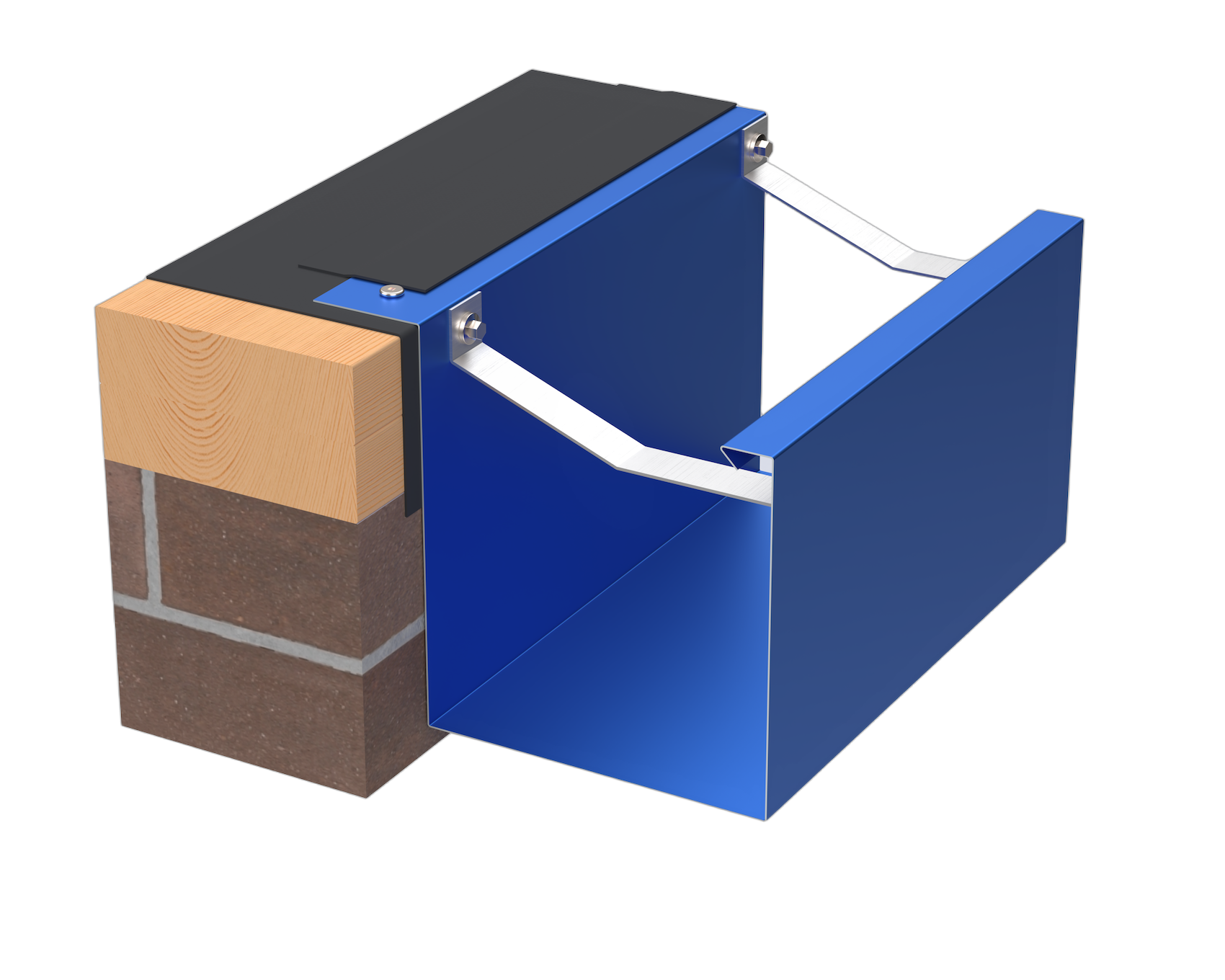
Edge metal, coping, and gutters are the perimeter systems that define how a commercial roof handles water at its boundaries, and in Lexington's building stock they are consistently the most neglected and most consequential components in the roof assembly. Walk the roofline of any Warehouse Block building on Manchester Street or any masonry commercial structure in the Distillery District and you're looking at coping conditions that range from functionally adequate to actively dangerous , cap stones that have lost their mortar joints, sheet metal coping that has lifted from freeze-thaw cycling, and counter-flashings that have separated from deteriorated reglets. These are not cosmetic issues. A failed coping cap or inadequate edge metal allows water to enter the top of a masonry parapet wall, where it saturates the masonry, freezes, expands, and progressively destroys the structural integrity of the wall itself.
Lexington's freeze-thaw cycle is the primary mechanism of coping failure on historic commercial buildings. The city records nearly 90 freezing-degree nights annually, which means any water that has entered a coping joint or a reglet in the fall is cycling in and out of freeze at least dozens of times before spring. Sheet metal coping relies on sealed joints between cap sections to prevent water entry, and those joints , typically filled with sealant at installation , begin to crack and open within 10 to 15 years on most buildings. Once the sealant fails, water enters the joint, gets behind the coping, and the freeze-thaw cycle begins its destructive work on the parapet masonry. We find masonry parapets on Warehouse Block buildings that have lost significant structural mass from freeze-thaw damage that originated at unfilled coping joints, sometimes requiring not just coping replacement but parapet reconstruction.
The masonry parapet buildings of Lexington's historic commercial districts present specific coping design challenges. Original stone coping on 19th and early 20th century buildings may be limestone , appropriate for the region but subject to the same freeze-thaw degradation as the brick beneath when water infiltration goes unchecked. When original stone coping is sound, we prefer to maintain it and address only the joint sealant and flashing conditions at the wall-to-roof interface. When stone coping is cracked or displaced, replacement with properly sloped sheet metal coping with correctly lapped and sealed joints is the appropriate solution. The slope detail matters: coping should drain positively to one face or the other, not sit flat, because flat coping holds standing water in every joint depression.
Counter-flashings at parapet walls are the component that connects the coping system to the roof membrane, and failures here account for a disproportionate share of wall-leak events on Lexington commercial buildings. A counter-flashing is a metal strip embedded in a reglet (a horizontal slot cut in the masonry) that laps over the top edge of the base flashing on the roof membrane side. When the reglet deteriorates or the counter-flashing pulls free , a common outcome of thermal movement on buildings without expansion provisions , water runs directly behind the base flashing and into the building interior. Re-cutting reglets and installing new counter-flashings on historic masonry parapets is precision work that requires the right tools and masonry experience; it's not a job that can be improvised with a surface-applied tape solution.
Gutter sizing for Lexington commercial buildings is frequently inadequate relative to the precipitation intensity the region experiences. The standard residential 5-inch K-style gutter that migrates into commercial construction on smaller office and retail buildings is designed for drainage intensity assumptions that underestimate what a Bluegrass summer storm delivers. Lexington's peak hourly rainfall intensity in a 10-year storm event is sufficient to overflow a 5-inch gutter on a roof plane of modest area. On commercial buildings with large unobstructed roof areas , a strip retail building along Beaumont Centre or a single-story medical office on Nicholasville Road , the gutter must be sized for the actual contributing roof area and the design storm intensity, not for what fits the fascia profile.
Gutter overflow on commercial buildings doesn't just mean water on the ground. Overflow that runs back under the eave fascia saturates the wall framing, degrades the soffit and fascia materials, and can introduce water into the wall cavity in quantities that cause structural damage over time. On metal commercial buildings along the I-75 industrial corridor, gutter overflow also accelerates corrosion at the eave trim and the base of the metal panel system. We evaluate gutter sizing and downspout placement on every edge metal project and recommend upsizing or adding downspouts when the existing configuration is undersized for the roof area.
Gravel stop and drip edge conditions on built-up and modified bitumen roofs require attention that sometimes gets deferred until the edge metal is visibly failing. The gravel stop holds the membrane edge at the perimeter and prevents membrane rollback, and when it corrodes or lifts from the substrate, the membrane edge becomes vulnerable to wind uplift. On Lexington's older BUR roofs , many of which have original gravel stops from the 1970s or 1980s , the metal is frequently corroded through at the base flange, which is also where it's most critical for preventing water entry along the membrane edge. Gravel stop replacement should be part of any re-roofing project on these older buildings, not an item that gets value-engineered out of the scope.
Downspout discharge locations on Lexington commercial buildings require evaluation alongside gutter sizing. A properly sized gutter system that discharges against the building foundation or into a saturated landscape area creates a different problem than gutter overflow, but the interior consequence , foundation water infiltration , can be worse. We include discharge assessment in every edge metal project and coordinate with site drainage requirements when discharge relocation is part of the recommendation. On buildings where underground drain connections to the storm system are feasible, that's typically the preferred outcome over surface discharge at the building perimeter.
Historic Distillery District buildings and adaptive reuse projects in the Warehouse Block district often have edge metal and gutter situations that require custom fabrication rather than standard stock profiles. Unusual fascia dimensions, historic building proportions that make standard gutter profiles look wrong, and structural constraints at the parapet that limit counter-flashing depth all require solutions that a contractor without sheet metal fabrication capability cannot provide. We fabricate custom coping and gutter profiles in-house when the project requires it, which gives us control over both the dimension and the material specification.
Questions Owners Ask
How do I know if my building's coping needs replacement?
Signs of coping failure include visible sealant cracking at joints, metal coping that has lifted or is visibly displaced, staining on the exterior parapet face from water tracking down the masonry, and interior wall moisture at the top of exterior walls. On historic masonry buildings, spalling brick or mortar loss below the coping line often indicates water has been entering the parapet through the coping system for some time. We inspect coping as part of every roof assessment on buildings with masonry parapets.
Why is my building leaking at the top of the interior walls rather than through the ceiling?
This pattern , water appearing at the top of interior walls rather than at ceiling penetrations , strongly suggests water entry through the parapet coping or counter-flashing rather than through the field of the roof membrane. Water entering the top of the masonry parapet migrates down through the wall assembly and appears at the interior wall surface, sometimes well below the roofline. The diagnostic approach is to inspect the coping joints, counter-flashing, and parapet cap condition rather than the membrane field.
What gutter size does my commercial building need?
Gutter sizing is calculated from the roof's contributing area and the design rainfall intensity for Lexington. As a general reference, a 6-inch box gutter or K-style gutter can handle significantly more flow than a 5-inch K-style, and the downspout spacing affects how quickly the gutter empties during a peak rain event. We perform a drainage calculation for any gutter replacement or new gutter project to ensure the system is sized for actual conditions rather than defaulting to whatever profile was installed previously.
Can coping be repaired rather than replaced?
Joint sealant replacement and isolated section repairs are viable when the underlying metal is structurally sound. When the metal coping has corroded significantly, has lifted sections, or has lost its drainage slope, replacement is the more cost-effective long-term solution. A sealant-only repair on coping with structural deficiencies provides temporary relief but not a long-term solution.
Do you handle both the roof membrane work and the edge metal on replacement projects?
Yes, and this integration is important. Roof replacement projects that separate the membrane work from the edge metal create coordination problems , the transition between the membrane and the coping or gravel stop is the most critical waterproofing detail at the roof perimeter, and it should be executed by the same contractor under a single warranty. We include all edge metal as part of our replacement scope rather than excluding it and leaving the building owner to coordinate a separate contractor for the perimeter.