
Warehouse Roofing in Lexington, KY from Commercial Roofing of Lexington.
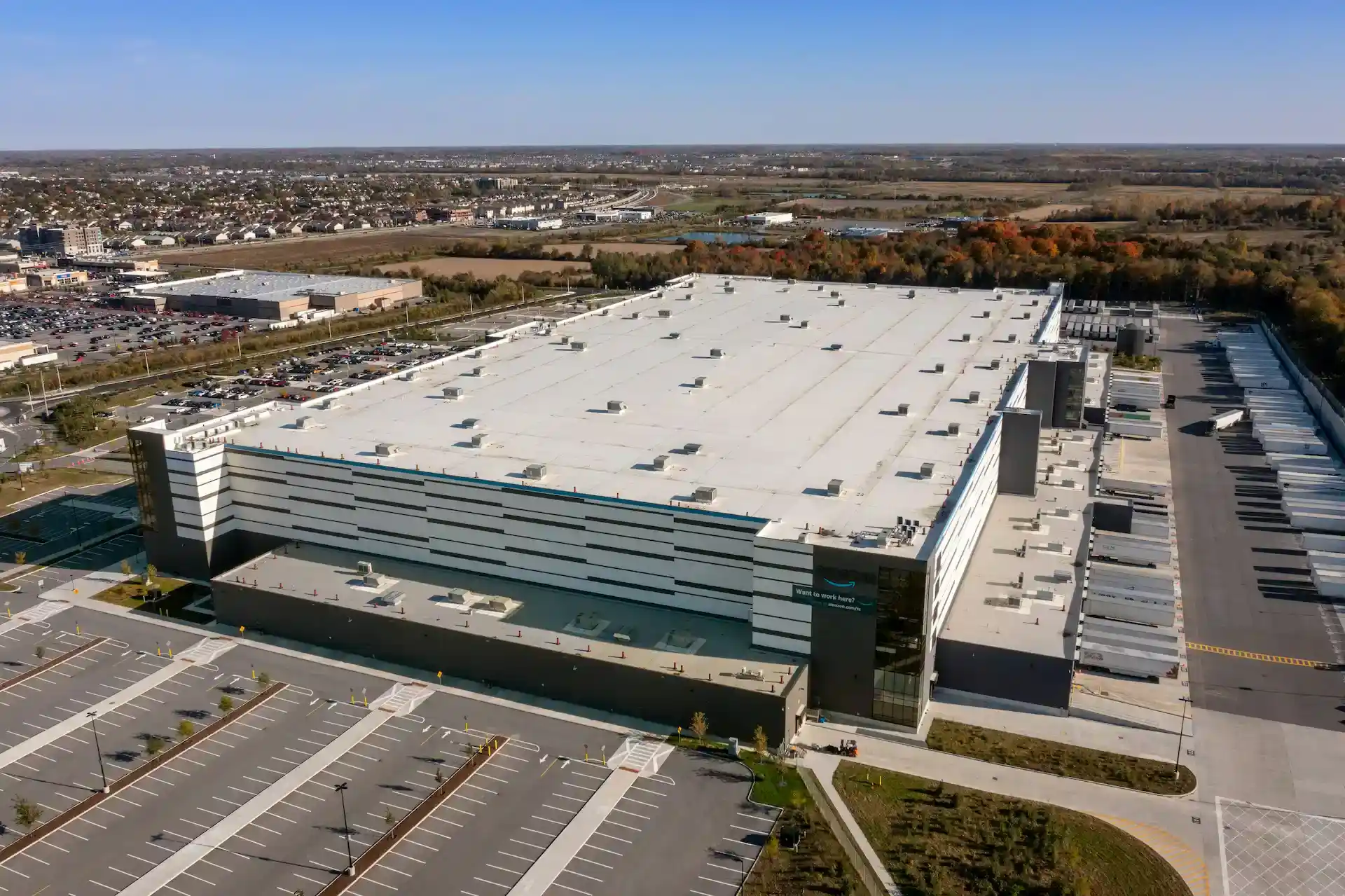
Amazon's massive fulfillment center on Patchen Drive in Lexington, Kentucky sets the standard for what warehouse roofing demands look like in the Bluegrass region. Facilities of that scale,running 24/7 with hundreds of dock doors and thousands of square feet of rooftop equipment,require a roofing system that handles every mechanical penetration cleanly while shedding Kentucky's unpredictable rainfall without ponding. When you operate or manage a large distribution or storage building in Lexington, the roofing decisions you make today determine your operational continuity for the next fifteen to twenty years.
Kentucky sits in a climatic middle ground that punishes roofing systems from both directions. Lexington averages around 45 inches of rain annually, with ice storms arriving in January and February capable of loading flat roofs beyond what poorly sloped systems can handle. Summer heat pushes surface temperatures on dark membranes above 160°F. Those extremes mean your membrane selection matters enormously: TPO has become the dominant choice for large Lexington warehouses because its white reflective surface reduces cooling loads significantly, and modern 60-mil and 80-mil sheets handle the thermal cycling well. EPDM remains a strong option for older buildings where budget drives decisions, particularly on shaded or north-facing sections, but TPO's energy performance advantage is real and measurable on utility bills in a facility running refrigeration or climate-controlled storage.
Drainage engineering on a 400,000-square-foot warehouse roof is not a detail,it is the central design challenge. A building of that size accumulates roughly 250,000 gallons of water during a 1-inch rainfall event. Primary drains set at 2% slope to the drain bowl must be sized for that volume, and secondary overflow scuppers need to be installed at code-required elevations so structural loads never build unnoticed. In Lexington, a common failure mode is the blocked primary drain during a leaf-heavy October storm. All primary drains at dock areas should be cleared on a quarterly schedule, and overflow scupper outlets should be inspected after every significant storm.
Dock penetrations are among the most technically demanding elements of any warehouse roof. Each dock leveler pit, electrical conduit bundle, and sprinkler riser that punches through the roof deck creates a point where water intrusion risk concentrates. Proper flashing at dock areas uses two-part pitch pockets filled with pourable sealer on smaller penetrations and pre-fabricated pipe boots for round conduits. On newer Lexington distribution facilities, the trend is to run mechanical conduits in interior chases where possible to reduce penetration count,but legacy buildings often have dozens of through-roof penetrations clustered near the dock apron that need annual inspection and periodic resealing.
Forklift exhaust equipment presents a specific challenge in warehouse roofing that office or retail projects never face. Propane forklift exhaust vents and battery charging ventilation stacks must be positioned and flashed so exhaust gases disperse away from HVAC fresh-air intakes. The flashing around these vents sees elevated thermal cycling from hot exhaust, which accelerates the degradation of standard pourable sealer. High-temperature silicone sealant and metal pitch pockets rated for the exhaust temperature are the correct specification for these penetrations, and they should be inspected twice annually rather than on the standard annual cycle.
Energy efficiency is increasingly a factor in Lexington warehouse leasing. Building owners competing for tenants from Amazon, UPS, and regional 3PL operators know that energy cost per square foot is part of every lease negotiation. A white TPO roof in Lexington will reflect enough solar energy to reduce peak cooling demand by 15-25%, which translates directly to smaller HVAC equipment at replacement time and lower monthly utility bills. Cool roof rebates from Kentucky Utilities are available for qualifying commercial projects and can offset a portion of the premium cost of 80-mil TPO over base-spec materials.
When a Lexington warehouse roof approaches the end of its service life, the choice between full tear-off and recover depends on deck condition and existing insulation R-value. Kentucky's energy code requires a minimum of R-25 for new commercial roofing assemblies, and a recover project that adds a layer of polyiso insulation under the new membrane can bring older buildings into compliance while avoiding the disposal cost of removing the existing system. A qualified infrared moisture scan should precede any recover decision to confirm that wet insulation is not being encapsulated, which accelerates decking corrosion and voids warranties.
Local contractors with warehouse-specific experience in Lexington include firms that have worked on the industrial parks along Newtown Pike, Man O' War Boulevard, and the Legacy Trail corridor. Look for contractors who carry a manufacturer certification,GAF, Carlisle, or Firestone,because certified contractors can offer 20-year or 30-year NDL (no-dollar-limit) warranties that cover both labor and materials. Roof warranties on a building this size represent real risk transfer, and a building owner who skips certification to save a few cents per square foot gives up leverage when a warranty claim eventually arises.
Budget planning for a large Lexington warehouse roof should account for roughly $8-$12 per square foot installed for a standard TPO recover, and $12-$18 for a full tear-off and replacement with new insulation. Emergency repairs after storm events are covered by commercial property insurance, but the claim process requires documentation of pre-loss condition. Annual inspection reports with photographs create the paper trail that speeds claim settlement. A Lexington commercial roofer who provides a written inspection report after each visit is providing value well beyond the maintenance work itself.
- What membrane is best for a large Lexington warehouse roof?
- TPO is the most common choice for Lexington warehouses because it combines heat-weld seam strength, UV resistance, and reflective energy performance. 60-mil or 80-mil TPO over polyiso insulation meets current Kentucky energy code and holds up well to the region's freeze-thaw and summer heat cycles.
- How often should dock penetration flashing be inspected?
- Dock area penetrations should be inspected at least twice per year,once in spring after winter ice cycles and once in fall before peak rainfall season. Any pitch pocket that shows cracking or separation from the membrane should be resealed immediately rather than deferred to the next scheduled visit.
- Does Lexington's climate require special drainage design for warehouse roofs?
- Yes. Lexington averages nearly 45 inches of annual rainfall and periodic ice storms. Primary drains must be sized for the full roof area and set at minimum 2% slope. Secondary overflow scuppers are required by code and must be kept clear to prevent structural overload during blocked-drain events.
- Can a warehouse roof be recovered rather than torn off?
- A recover is often viable and more cost-effective than full tear-off, but only if an infrared moisture scan confirms dry insulation. Wet insulation encapsulated under a new membrane will continue to deteriorate and will void most manufacturer warranties. Kentucky energy code also requires the final assembly to meet R-25 minimum, which may require adding insulation during a recover.
- What does a 20-year NDL warranty cover on a warehouse roof?
- A no-dollar-limit warranty covers both the cost of materials and the contractor's labor to repair any warranted failure for the full term. It requires installation by a manufacturer-certified contractor and typically requires annual inspections to keep the warranty active. It is the strongest warranty product available and is worth the modest premium on a large industrial building.