
Roof Recover Overlay in Lexington, KY from Commercial Roofing of Lexington.
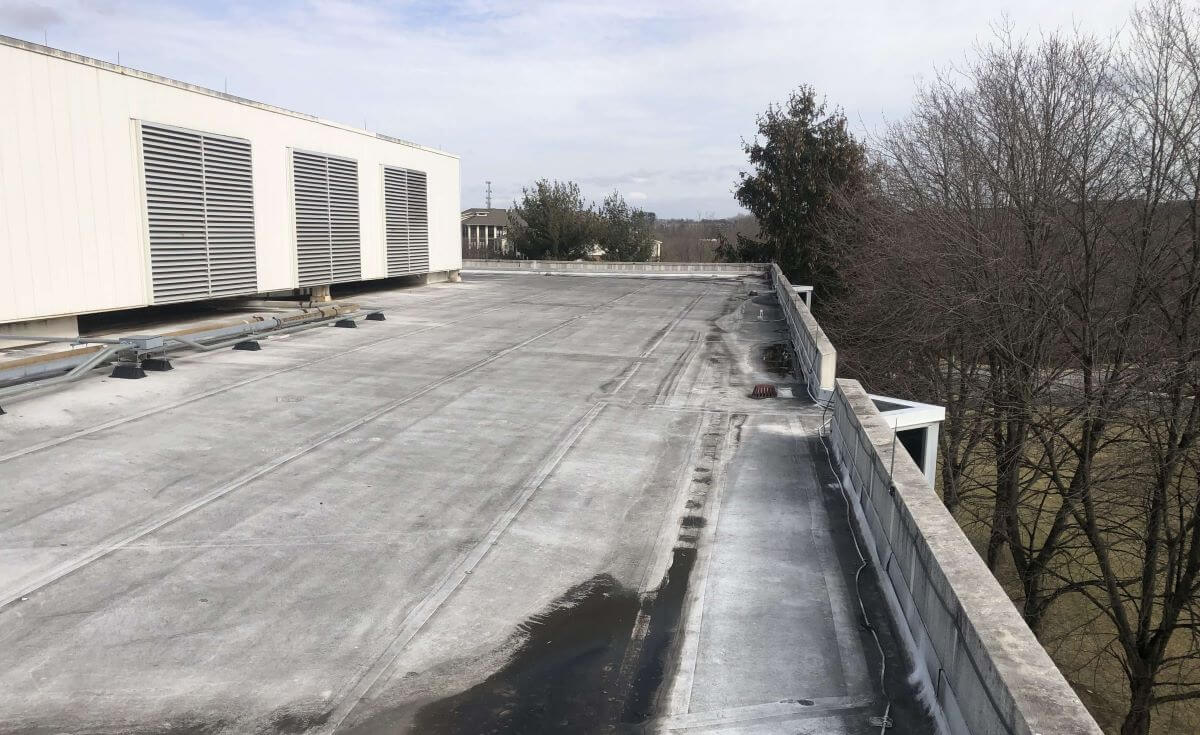
A roof recover , installing a new membrane system over an existing roofing assembly without removing the old one , is the right decision for a specific category of Lexington commercial buildings, and the wrong decision for a different category that superficially resembles it. The evaluation process that distinguishes between the two is more rigorous than many building owners expect, and the consequences of getting it wrong are severe: a recover installed over wet insulation seals in moisture that continues to degrade the assembly from within, producing premature failure of the new membrane and eliminating any recovery value from the insulation investment. Done correctly on the right building, a recover defers a major capital expenditure by 15 to 20 years while delivering a fully warranted new membrane system.
The two qualifying conditions for a recover project are straightforward in principle. First, the building cannot already have a prior recover layer , the International Building Code limits commercial buildings to two total roofing assemblies, and a building that already carries one recover has reached that limit. Full tear-off is required at that point. Second, the existing insulation must test dry. This isn't a visual judgment call , it requires an infrared moisture scan followed by core sampling to confirm the scan findings. The infrared scan identifies areas of elevated moisture through differential thermal mass; the core cuts verify what the scan indicates. A building with even 20 to 25 percent of its insulation area showing moisture infiltration is typically not a good recover candidate, because the new membrane will eventually reflect the insulation failure below it through fastener back-out, membrane wrinkle patterns, and accelerated deterioration in the wet zones.
Legacy Business Park office buildings are among the strongest recover candidates in the Lexington commercial market. Many of these buildings , constructed in the 1990s and early 2000s , have original TPO or EPDM membranes approaching the end of their design service life, but the insulation beneath them often tests dry because the membranes, while aged, have not experienced the catastrophic failures that introduce widespread moisture. A Legacy Business Park building with dry insulation, a membrane that is at end of life, and no prior recover layer is a textbook recover candidate. The recover eliminates tear-off and disposal costs, preserves the existing insulation investment, adds a new code-compliant insulation layer on top of the existing assembly, and delivers a new warranted membrane , typically at 60 to 70 percent of full replacement cost.
Recovery board is the component that bridges the old assembly and the new membrane, and its selection matters more than its modest cost suggests. Recovery board , typically half-inch high-density polyisocyanurate, wood fiber board, or gypsum board , provides a smooth, stable, code-required separation layer between the existing membrane surface and the new membrane above. It distributes fastener loads across the substrate rather than concentrating them at fastener points, which prevents fastener back-out that would otherwise occur as the assembly settles. It also provides the clean bonding surface that fully-adhered new membrane systems require, since the weathered surface of an existing 20-year-old membrane does not provide adequate adhesion for a new fully-adhered system.
Attachment method selection for the recover system , mechanically fastened, fully adhered, or ballasted , depends on the existing assembly's composition and the structural deck's fastener pullout capacity. On a concrete or structural steel deck, full adhesion is typically the preferred attachment for single-ply membranes because it eliminates the thermal bridging associated with mechanical fasteners and produces the highest wind uplift resistance. On lightweight concrete decks , common on older UK campus buildings and 1970s commercial construction in Lexington , fastener pullout testing is required before specifying a mechanically fastened recover system, because the deck's capacity may not support the design fastener pattern without modification.
Tapered insulation added as part of a recover project addresses the drainage problems that many Lexington flat roofs have accumulated over their service life. When a building has chronic ponding in low areas, a recover is the opportunity to install tapered recovery board or tapered insulation that creates positive slope to the drains , effectively correcting the drainage design without structural modification. This is one of the most compelling economic arguments for the recover approach: the tapered insulation that solves the ponding problem is a smaller incremental cost when integrated into the new recover assembly than it would be as a standalone drainage correction on an otherwise sound roof.
Older Lexington commercial buildings where the existing membrane condition is marginal , not actively failing but showing significant surface oxidation, granule loss on modified bitumen, or seam condition that suggests limited remaining life , are candidates for a recover scope assessment before any significant investment in repairs is made. A building that needs $40,000 in repairs to extend its life three to five years may be a better candidate for an $80,000 recover that delivers 15 to 20 years of warranted performance than for the repair investment. We model this economics comparison for building owners who are at this decision point, using current cost data rather than rule-of-thumb percentages.
The recover scope specification should include all flashings, not just the field membrane. A new membrane layer over an existing assembly that retains the original aged wall flashings, pipe flashings, and equipment curb flashings is a new system with old failure points. We specify complete flashing replacement as part of every recover scope , the cost of flashing materials is modest relative to the total recover cost, and leaving aged flashings in place defeats a significant portion of the new assembly's performance value.
Permitting requirements for roof recover projects in Lexington-Fayette County include building permit applications to the Division of Building Inspection, with energy code compliance documentation showing that the new assembly meets minimum insulation requirements. Adding insulation in the recover assembly , as a tapered layer or as a flat new iso layer over the recovery board , is typically necessary to meet current IECC requirements when the existing insulation alone is below the code minimum. We prepare the permit documentation as a standard project deliverable and ensure energy code compliance is addressed in the specification rather than discovered during the permit review process.
Questions Owners Ask
How do I know if my building qualifies for a recover?
Two tests: first, confirm that your building has not already had a prior recover layer by reviewing any available roofing history or by having us conduct a core sample to identify how many membrane layers are present. Second, conduct an infrared moisture scan and core sampling to determine insulation moisture content. If the building passes both tests , one membrane layer and dry insulation , recover is worth evaluating as an alternative to full replacement.
What's the cost difference between a recover and a full replacement?
Recovers typically cost 60 to 70 percent of a full replacement on comparable buildings because they eliminate tear-off labor and disposal costs, which represent a significant fraction of a replacement project budget. The recover also preserves the existing insulation investment. On large commercial buildings , 50,000 square feet or more , the absolute dollar difference between recover and replacement can be substantial, making the qualification assessment investment worth making before defaulting to tear-off.
Does a roof recover void the existing roof warranty?
A recover typically terminates any remaining coverage under the original membrane warranty, because the new assembly changes the conditions of the original warranted system. The new recover assembly carries its own manufacturer and workmanship warranty from the date of installation. For buildings with active warranty coverage on the existing system, review the warranty terms and consult with the original manufacturer before proceeding with a recover.
Can a recover fix my building's ponding problem?
Yes, if the recover specification includes tapered insulation or tapered recovery board that creates positive drainage slope to the roof drains. A recover without drainage correction simply installs a new membrane over the same drainage configuration, and the ponding problem continues under the new membrane. We include drainage evaluation as part of every recover assessment and propose tapered components when positive slope is achievable within the recover scope.
What happens to the old membrane during a recover?
The existing membrane remains in place, beneath the new recovery board and new membrane. It is not removed or modified. This is what preserves the existing insulation and avoids tear-off costs. The existing membrane becomes part of the composite assembly and its condition , sound enough to serve as a stable substrate , is one of the qualifications we assess before approving a recover approach.