
TPO Roofing in Lexington, KY from Commercial Roofing of Lexington.
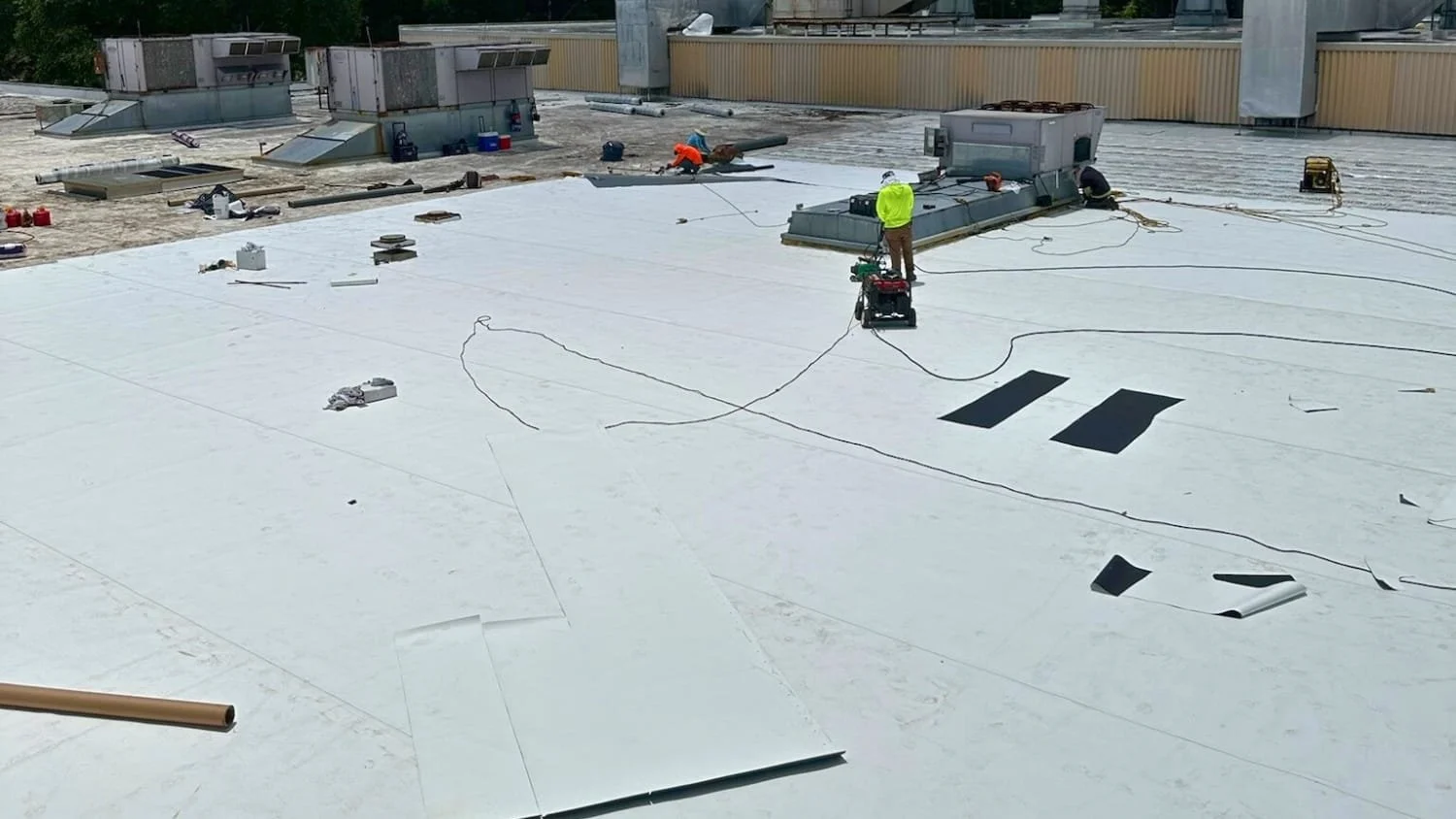
TPO , thermoplastic polyolefin , has become the dominant single-ply roofing membrane on new commercial construction in Lexington over the past 15 years, and for straightforward reasons: it's white and reflective, it's heat-welded at seams for a strong and inspectable bond, it's cost-competitive with EPDM on installation, and it performs well in Lexington's climate when properly specified and installed. Coldstream Research Campus, Legacy Business Park, and the commercial corridors along Man o' War Boulevard and Richmond Road have accumulated substantial TPO inventory as these areas developed and re-roofed through the 2010s and 2020s. Understanding how TPO performs in Lexington's specific climate conditions , and what the variables are that determine whether a given installation achieves its design life , is the foundation of a competent TPO maintenance and replacement program.
Seam quality is the single most important variable in TPO roofing performance, and Lexington's climate tests seams in ways that reward proper installation and expose shortcuts. A correctly executed hot-air weld on TPO fuses the two membrane surfaces into a homogeneous bond that is as strong as the field membrane itself , the seam cannot be separated without tearing the membrane. An under-welded seam , one where the heat gun was moved too quickly, the surface temperature was too low, or the surface was contaminated , has a bond that looks continuous but has adhesion voids that open under thermal cycling. Lexington's 25-plus days above 90°F in summer and nearly 90 freezing-degree nights in winter impose a substantial thermal cycling load on every seam, and the under-welded seam that holds together at the initial pull test may have opened measurably after five seasons of this cycling.
TPO membrane thickness is a specification variable that affects long-term performance in ways that aren't immediately visible. The commercial TPO market offers 45-mil, 60-mil, and 80-mil products, and the gap in performance between them in Lexington's climate is significant. A 45-mil TPO membrane is the thinnest commercially available product , it meets code minimum requirements but has less material reserve for puncture resistance, seam strength, and weathering tolerance than a 60-mil product. On Coldstream Research Campus buildings where rooftop equipment service creates regular foot traffic across the membrane, on Legacy Business Park warehouses where forklift operations on adjacent loading docks occasionally contact the roof surface, and on any building where the membrane is expected to perform for 20-plus years in Lexington's heat-freeze cycling environment, 60-mil TPO is the appropriate minimum specification. We do not specify 45-mil TPO on commercial projects where a 20-year or longer service expectation is realistic.
Attachment method selection for TPO on Lexington commercial buildings involves a tradeoff between installation cost and long-term performance. Mechanically fastened TPO , where the membrane is attached with screws and plates at specified intervals , is faster and less expensive to install than fully adhered TPO, but it creates thermal bridges at every fastener location that reduce effective insulation R-value and concentrates stress at fastener points under wind uplift loading. Fully adhered TPO eliminates both of those liabilities at a higher installation cost. On buildings where thermal performance is a priority , research buildings at Coldstream, medical offices where the roof assembly is part of the building's energy envelope , fully adhered TPO is the better long-term specification. On large-footprint warehouses at Legacy Business Park where the installation economics favor mechanical attachment and the thermal bridge effect is less consequential relative to the total building envelope, mechanically fastened TPO is appropriate.
TPO color stability is a performance characteristic that building owners should understand before assuming a white roof stays white indefinitely. TPO membranes use titanium dioxide as the reflective pigment, and while modern TPO formulations are significantly more stable than early-generation products, the reflectivity of a TPO membrane does decrease somewhat over time from dirt accumulation, biological growth, and photochemical weathering of the surface layer. The reflectivity reduction is typically modest over the first 10 to 15 years on well-drained roofs, but on Lexington commercial buildings with chronic ponding , where algae and biological growth establish on standing water surfaces , the dark growth colonies on the membrane surface can significantly reduce reflectivity in low areas. Drain maintenance that prevents chronic ponding is part of the energy performance maintenance program for a white reflective roof.
TPO compatibility with chemical exhaust is the specification variable that PVC and KEE address for food-service and chemical manufacturing applications. Standard TPO is not resistant to the animal fats and grease oils in restaurant exhaust , the membrane swells and degrades in the exhaust influence zone around commercial kitchen ventilation. Lexington's restaurant concentration along Nicholasville Road, Hamburg Pavilion, and the Summit at Fritz Farm means this compatibility issue comes up regularly in specification conversations. For food-service buildings, PVC or KEE should be specified in the exhaust influence zone, not standard TPO. For general commercial buildings without food-service or chemical exhaust, TPO is fully appropriate.
Re-roofing existing TPO systems in Lexington , a growing project category as the first generation of TPO installations from the early 2000s approaches end of service life , involves the same recover versus tear-off evaluation as any membrane system. Dry insulation and no prior recover layer qualify a building for a recover; wet insulation or a prior recover layer require tear-off. The substrate condition of an aged TPO membrane , whether it provides adequate adhesion for a new fully-adhered system or adequate fastening pullout for a mechanically fastened recover , should be assessed before the recover specification is finalized. A 20-year-old TPO membrane may have adequate structural integrity for a recover substrate or may have lost dimensional stability in ways that make it unsuitable without additional preparation.
TPO maintenance in Lexington's commercial market centers on seam and flashing condition, drain management, and periodic surface inspection for puncture damage and membrane wrinkle patterns that indicate fastener back-out or substrate movement. Annual inspection of all seam perimeters and flashing terminations, prompt repair of any open seam edges, and drain cleaning to prevent the biological growth that reduces reflectivity are the core maintenance activities. Buildings that receive this maintenance on a regular cycle consistently achieve service lives at or above the 20-year design expectation; buildings managed reactively , responding only to active leaks , frequently require premature replacement driven by accumulated seam failures and widespread flashing deterioration.
We maintain manufacturer certification programs with major TPO producers, which allows us to offer enhanced warranty coverage , including labor and material warranties at extended terms , that non-certified installers cannot provide. For building owners at Coldstream Research Campus and Legacy Business Park who are making 20-year-plus membrane decisions on large commercial buildings, the warranty coverage difference between certified and non-certified installation is worth understanding before selecting a contractor on price alone. The manufacturer's enhanced warranty provides coverage for both material and labor costs on qualifying defects for the warranty period , a meaningful financial protection on a $500,000 re-roofing project.
Questions Owners Ask
How long should TPO roofing last on a Lexington commercial building?
A properly installed 60-mil TPO system with regular maintenance should achieve 20 to 25 years of service life in Lexington's climate. Early-generation TPO from the late 1990s and early 2000s used formulations that had more variable performance; current TPO products from major manufacturers are significantly more consistent. Membrane thickness, seam quality, and maintenance program quality are the variables that most determine where within that range a specific installation lands.
Why is my TPO roof forming wrinkles and bubbles?
Wrinkles in TPO membrane typically indicate one of three conditions: fastener back-out where mechanically attached plates are losing their grip in the substrate, allowing the membrane to move; moisture vapor from wet insulation below that is creating pressure against the underside of the membrane; or thermal expansion in a membrane that was installed without adequate accommodation for expansion at fixed perimeter terminations. Bubbles that are firm suggest trapped moisture or vapor below the membrane; bubbles that deflate under pressure suggest entrapped air during installation. Each condition requires diagnosis before repair, because the correct repair method depends on the root cause.
Is TPO better than EPDM for Lexington's climate?
They have different strengths in this market. TPO's white reflective surface is a meaningful energy performance advantage over black EPDM. TPO's heat-welded seam is more reliable and inspectable than EPDM's adhesive lap. EPDM has a longer performance history and proven durability through Lexington's freeze-thaw cycling. EPDM's rubber chemistry is more flexible at low temperatures than some TPO formulations. For most new commercial installations in Lexington, 60-mil TPO is our standard recommendation, but we evaluate EPDM where the building's specific conditions favor its characteristics.
Can TPO be repaired after a storm or physical damage?
Yes. TPO membrane repairs use the same hot-air welding process as new installation , a TPO patch welded over the damaged area creates a bond equivalent to the original membrane. The repaired area should be slightly larger than the visible damage to ensure a clean weld perimeter on undamaged membrane. TPO is one of the more straightforward membranes to repair in the field because the welding process is reliable when executed at proper temperature and speed on a clean surface.
What should I look for when comparing TPO installation bids?
Membrane thickness (60-mil minimum for commercial applications), attachment method and fastener pattern, insulation specification and R-value, flashing scope (ensure all penetrations and wall terminations are included), warranty terms and whether the contractor is manufacturer-certified for enhanced warranty coverage, and references on comparable Lexington commercial buildings. A bid that specifies 45-mil membrane and a minimum fastener pattern is not the same product as a 60-mil fully adhered specification, regardless of whether the line items use the same terminology.