
Commercial Metal Roofing in Lexington, KY from Commercial Roofing of Lexington.
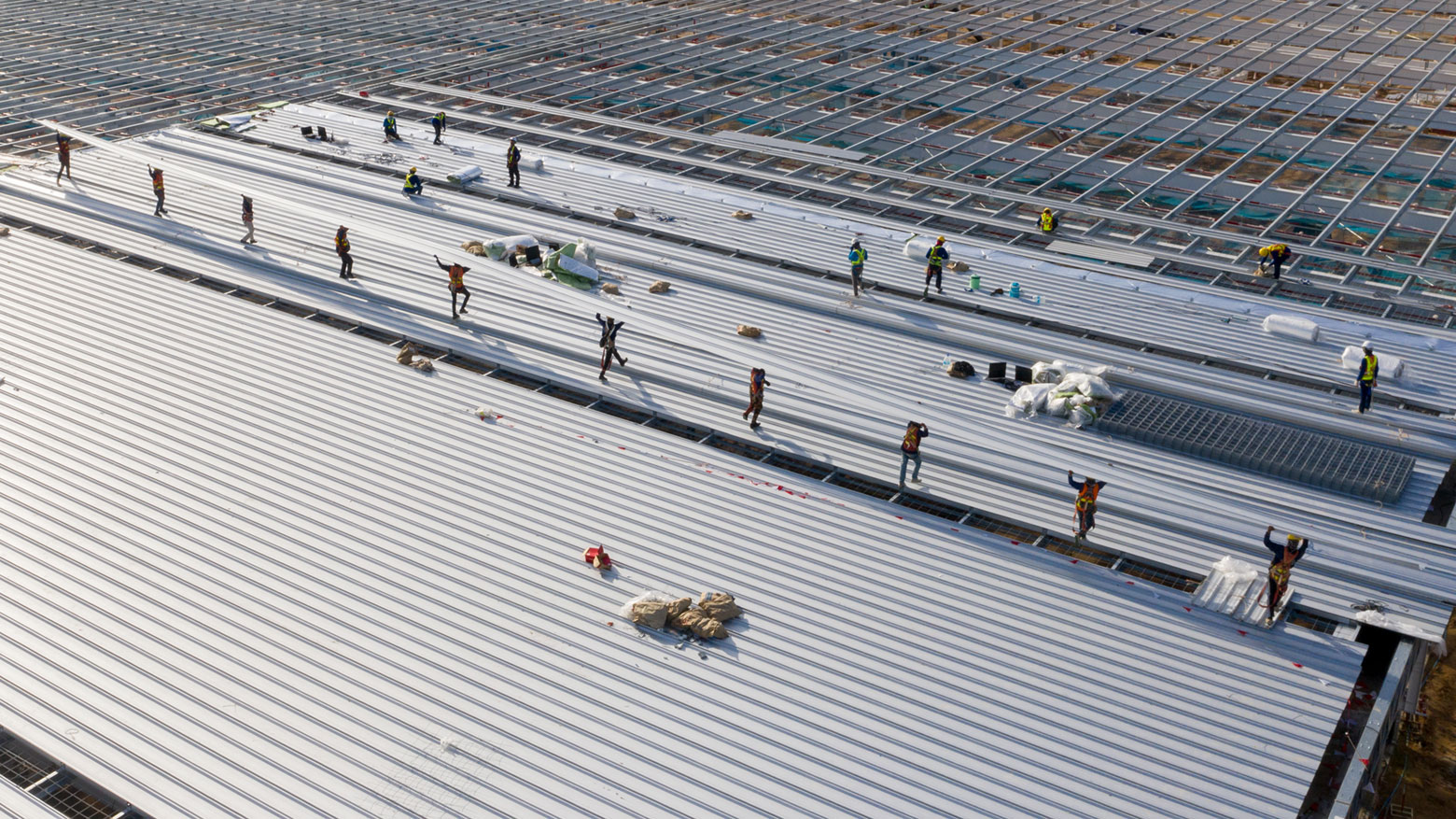
Metal roofing is the dominant system on Lexington's industrial and light-manufacturing corridor, and for good reason. From the auto-supplier campuses along Georgetown Road feeding Toyota's Georgetown plant to the tilt-up distribution buildings clustered around Bluegrass Station and the research facilities at Coldstream Research Campus, exposed-fastener R-panel and concealed-fastener standing seam represent the bulk of the low-slope and steep-slope commercial metal stock in Fayette County. Understanding which system is installed , and what its fastener pattern means for long-term performance , is the first question we ask when we receive a maintenance or repair call.
R-panel systems with exposed fasteners are the workhorse of the local industrial market. They're faster to install, less expensive per square foot, and entirely appropriate for the warehousing, light assembly, and distribution uses that occupy Legacy Business Park, the I-75 commercial spine, and the supply-chain facilities along Newtown Pike. The performance limitation is the fastener itself: over-driven screws compress the neoprene washer and under-driven screws leave it unseated, and either condition leads to leaks within a few seasons. On Lexington's older R-panel buildings , those installed in the 1990s build-out of Legacy Business Park , we regularly find panels where the original fasteners have backed out from thermal cycling and need re-setting or replacement before any coating work makes sense.
Thermal movement is the governing engineering variable for metal roofing in the Bluegrass climate. Lexington records 25-plus days above 90°F in summer and nearly 90 freezing-degree nights in winter, which means a standing seam panel running 40 feet up a Coldstream Research Campus building is moving more than half an inch between its seasonal extremes. Concealed-fastener standing seam systems are engineered to accommodate this movement through floating clip assemblies that allow the panel to move without stressing the panel itself or the attachment. Exposed-fastener systems, by contrast, fix the panel at each screw location , which is why older R-panel roofs often show distorted ribs and elongated screw holes on buildings where thermal movement wasn't accounted for in the original design.
Lexmark International's Lexington facilities and the Lockheed Martin plant represent the kind of high-square-footage metal roofing assets where systematic maintenance programs have the clearest ROI. A 200,000-square-foot R-panel roof with 18,000 fasteners doesn't have a maintenance problem that announces itself , it has 50 fasteners that are slowly backing out or have cracked washers, and those 50 locations are next year's active leaks. Our metal roof maintenance program includes a systematic fastener inspection and re-torque sweep, seam sealant inspection, and ridge cap and eave trim assessment every two to three years on these large-format industrial buildings.
Restoration coatings extend the service life of metal roofs significantly, and the economics are compelling on large-footprint industrial buildings. Before we specify any coating system, however, we conduct a substrate assessment that goes beyond surface rust. Metal panel corrosion that has advanced to perforation , even pinhole perforation , cannot be corrected by coating alone. We identify those panels for replacement, prime and treat areas with surface oxidation, re-bed all fastener heads with butyl sealant, and then apply the coating system over a properly prepared substrate. An elastomeric or silicone coating applied over failed panels or un-addressed fastener voids will fail at those same locations within 18 months.
Gutters and downspout sizing on metal buildings are frequently undersized relative to Lexington's heavy-rain months. The five-inch May rainfall events that the Bluegrass region sees regularly overwhelm standard 4-inch K-style gutters on low-pitch metal buildings, leading to overtopping that drives water back under the eave trim. On auto-supplier facilities with large unobstructed roof planes, we often recommend upsizing to 6-inch box gutters with increased downspout frequency as part of any comprehensive metal roof restoration project.
Penetration flashing is the most common source of active leaks on metal commercial buildings. Stack flashings, roof curbs for HVAC equipment, and pipe boots all represent interruptions in the panel plane where water management depends entirely on the quality of the original installation and the condition of the sealant. On Coldstream Research Campus buildings, where rooftop mechanical density is high relative to a typical warehouse, we often find four or five deficient penetration flashings per 10,000 square feet of roof area on buildings that haven't had systematic maintenance. Replacing or re-sealing these details is almost always the highest-priority repair item on any metal building assessment.
New metal roofing specifications for Lexington commercial buildings should account for wind uplift requirements specific to Kentucky's exposure categories. Buildings on open-site layouts , like those on the outer parcels of Legacy Business Park or along the Man o' War Boulevard commercial corridor , face higher design wind speeds than infill urban buildings, and the attachment pattern and panel gauge need to be specified accordingly. We design to the current International Building Code wind maps rather than assuming the original building permit reflects current requirements, particularly on older facilities that predate recent code cycles.
For building owners evaluating new construction or a complete re-roof in metal, the standing seam versus R-panel decision ultimately comes down to application, budget, and long-term maintenance philosophy. Standing seam costs more upfront but eliminates the fastener maintenance problem entirely, making it the preferred specification for occupied research buildings, medical offices, and corporate campuses where interior disruption from a leak event is unacceptable. R-panel remains a sound, cost-effective choice for warehousing and light industrial applications where the maintenance program is in place to monitor fastener condition systematically.
Questions Owners Ask
How often should exposed-fastener R-panel roofs be inspected?
Every two to three years at minimum, and after any significant hail or wind event. The fastener washers begin to harden and crack within 10 to 15 years on most systems, and a systematic re-torque and sealant sweep at that interval is far less expensive than the interior damage that results from multiple simultaneous fastener leaks during a heavy rain event.
Can a metal roof be coated instead of replaced?
Yes, if the substrate is sound. We assess panel condition carefully before recommending any coating system , panels with perforation corrosion need replacement, not coating. On a metal building where the panels themselves are structurally intact but surface rust and minor coating failure are present, a properly applied elastomeric or silicone system can add 15 to 20 years of service life at a fraction of replacement cost.
What's causing my metal building to leak at the ridge?
Ridge cap failure is one of the most common metal building leaks we diagnose. The ridge cap closure foam deteriorates over time, the cap fasteners back out, and wind-driven rain enters along the full ridge length. In some cases the original closure foam was never installed correctly or was omitted entirely. Ridge cap replacement and proper foam closure installation is typically a straightforward repair.
My building is near the Toyota supply chain corridor , do you work on those building types?
Yes. We work regularly on the auto-supplier facility type , tilt-up, pre-engineered metal buildings, and hybrid structures , along Georgetown Road, Newtown Pike, and the I-75 industrial corridor. These buildings often have large unobstructed roof planes with relatively few penetrations, which makes systematic maintenance efficient to execute.
What's the difference between concealed-fastener and exposed-fastener metal roofing for maintenance purposes?
Concealed-fastener standing seam systems have no exposed screw heads in the field of the roof , attachment is through a clip hidden under the panel rib. There are no fastener washers to inspect or replace, and thermal movement is accommodated by the floating clip rather than the panel itself. Exposed-fastener R-panel systems require periodic inspection and re-torque of thousands of individual screws. Long-term, standing seam has substantially lower maintenance cost, which is why we specify it for occupied buildings where maintenance access is difficult or disruptive.