
Wind Driven Rain Roof Repair in Lexington, KY from Commercial Roofing of Lexington.
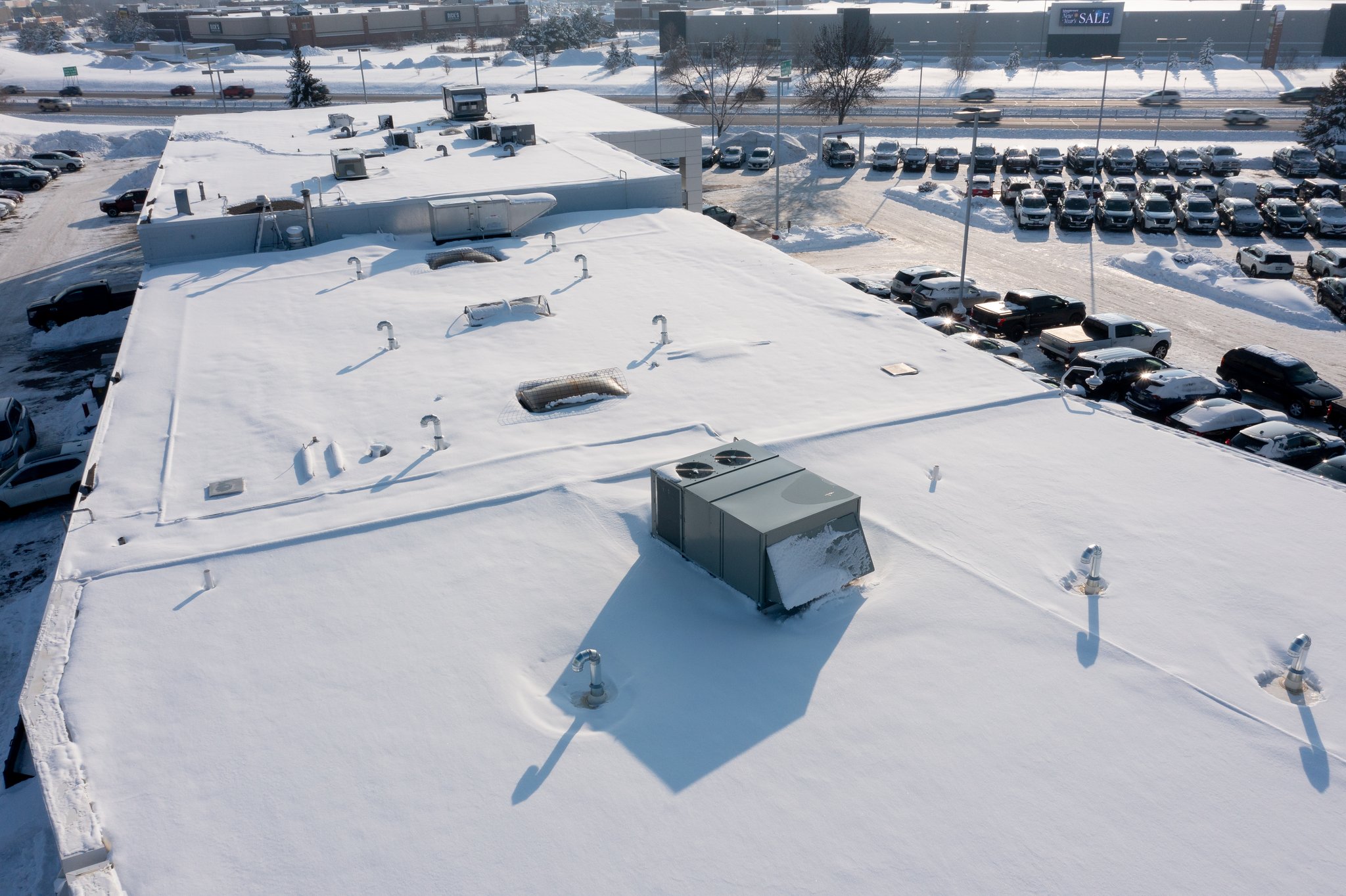
Wind-driven rain is a different problem from a roof leak, and the distinction matters because the entry point and the repair approach are different. A conventional roof leak originates at a membrane failure, a flashing separation, or a penetration deficiency , water enters the assembly from above through a break in the roofing system. Wind-driven rain enters a building horizontally: at parapet wall joints, at wall-to-roof transitions, through window and door head flashings, at masonry mortar joints above grade, and at any gap or material transition that faces into prevailing wind during a storm event. The roof membrane may be entirely sound while wind-driven rain is causing significant interior damage through the building's vertical envelope. Diagnosing this correctly means following the water from the interior stain back to the actual entry point rather than automatically assuming the problem is a roof failure.
Lexington's thunderstorm character drives the wind-driven rain problem. Bluegrass region convective storms , the kind that develop rapidly on summer afternoons and push through the metro with strong leading-edge winds before the main rain arrives , produce horizontal precipitation rates that expose every building face to water infiltration risk. A northeast-facing parapet wall that performs adequately in normal vertical rainfall becomes a water entry source when storm winds from the southwest are driving rain at a 45-degree angle against it. The buildings that show this failure most acutely are those with masonry parapet walls , the Warehouse Block historic commercial buildings on Manchester Street, the brick commercial buildings in the Distillery District, and the older masonry-faced office buildings throughout downtown Lexington and Chevy Chase.
Parapet wall-to-roof joint failures are the most common source of wind-driven rain intrusion on Lexington commercial buildings. The transition between the roof membrane and the vertical parapet wall requires a base flashing that runs up the parapet face and a counter-flashing that laps over it , a two-piece system that allows the membrane to move relative to the wall while maintaining a continuous waterproofing plane at the transition. When this joint deteriorates , from counter-flashing separation, from base flashing adhesion failure, or from sealant failure at the counter-flashing termination , wind-driven rain during a storm event can enter the wall-to-roof joint in quantities that appear disproportionate to the size of the opening. The pressure differential between the windward face and the building interior during a storm creates a suction effect that actively draws water into any gap at this transition.
The Warehouse Block buildings on and near Manchester Street represent Lexington's most concentrated population of wind-driven rain vulnerable buildings. These are 19th and early 20th century masonry construction , heavy brick walls, limestone sills and lintels, original mortar joints that range from well-maintained to significantly deteriorated. The adaptation of these buildings to commercial office, event, and creative industry uses has added rooftop HVAC equipment and penetrations that create new wall-to-roof transitions at locations where the original building had none. Each new penetration through an older masonry wall is a potential wind-driven rain entry point if the flashing at the wall opening wasn't executed with attention to horizontal water infiltration , not just vertical drainage.
Distillery District buildings present similar masonry vulnerability with an additional complication: many have been through multiple adaptive reuse projects that have added windows, doors, and ventilation openings to original solid masonry walls. Each of these openings requires a properly flashed head condition to prevent wind-driven rain from entering at the window or door frame. Head flashings on historic masonry buildings are often embedded in the masonry course above the opening, and when the mortar joint at the flashing base fails, wind-driven rain tracks behind the flashing and into the wall cavity. The interior symptom , staining below a window on an upper floor , doesn't suggest a roof problem to the casual observer, but a careful diagnostic often connects it to a masonry head flashing failure that is a roofing contractor's scope when the flashing involves the roof-to-wall transition.
Roof-level parapet cap conditions are directly connected to wind-driven rain infiltration in ways that building owners frequently don't recognize. A parapet cap that has failed coping joints allows wind-driven rain to enter the top of the masonry wall, which then distributes moisture downward through the wall assembly and outward at any weak point in the wall face or interior finish. The building owner sees moisture on the interior wall surface and assumes it's a roof problem , and in a sense it is, because the coping is part of the roofing system , but the repair is coping joint restoration and counter-flashing work, not membrane repair. We assess coping and parapet conditions as part of every wind-driven rain investigation rather than limiting the diagnostic to the roof membrane surface.
Sealant joint failures at building expansion joints, control joints, and window perimeters contribute to wind-driven rain infiltration on commercial buildings across Lexington's building stock. These joints are typically maintained by the building envelope contractor rather than the roofing contractor, but on older buildings where the original sealant has never been replaced, the failed joint condition at window perimeters and control joints can account for significant interior moisture intrusion during storm events that is incorrectly attributed to roof failure. We identify these conditions during wind-driven rain investigations and either address them within our scope or refer them to an appropriate building envelope contractor when the sealant work is outside the roofing interface.
Amazon's distribution facility in Fayette County and the large-format industrial buildings at Legacy Business Park and Bluegrass Station represent a different wind-driven rain profile from the historic masonry buildings. Metal-panel commercial buildings have their own horizontal infiltration vulnerabilities: trim laps where wind-driven rain can track behind the metal panel, flashings at wall-to-roof transitions on tilt-up construction, and gutter back-flow at eaves when rain volume exceeds gutter capacity and drives water back under the eave flashing. We evaluate metal building wind-driven rain entry through a systematic trim and transition inspection that is distinct from the masonry building diagnostic.
Documentation of wind-driven rain investigations should capture not just where water appeared inside the building, but the storm conditions under which it appeared , wind direction, storm intensity, and whether the infiltration is consistent with a specific wind direction rather than omnidirectional. A building that only shows interior moisture after storms arriving from the southwest is providing diagnostic information: the southwest-facing envelope is where the investigation should focus. We gather this building history from the facilities manager or building owner before starting the exterior investigation, because the storm-direction pattern often cuts the diagnostic work significantly and focuses attention on the actual problem side of the building.
Questions Owners Ask
My building only leaks during heavy storms , is that a roof problem or a wall problem?
Storm-only infiltration that appears at walls or upper wall-ceiling junctions , rather than at ceiling field locations below the roof plane , is more characteristic of wind-driven rain through the building envelope than a roof membrane failure. The roof membrane typically leaks at any significant rainfall once it has failed, not only during wind-driven events. The storm-only pattern and the interior location of the stain are both diagnostic clues pointing toward the wall-to-roof transition, coping, or building envelope rather than the field membrane.
What does a wind-driven rain investigation involve?
We start with the interior , documenting where water appears, on what wall face, and under what storm conditions. We then inspect the exterior envelope at the corresponding locations: coping and parapet cap joints, counter-flashing terminations, base flashing condition at wall-to-roof transitions, window head flashings, and any sealant joints at material transitions. On masonry buildings, we probe mortar joint condition in areas that correspond to interior moisture locations. We follow the water path from inside to outside rather than assuming the problem is in any one component.
Can masonry repointing fix a wind-driven rain problem?
Masonry repointing addresses one potential wind-driven rain entry path , open mortar joints in the wall face , but it rarely solves the complete problem on its own. If the coping cap joints are open, the counter-flashing is separated, or the window head flashing has failed, repointing the wall face below those conditions simply slows the water at the face while the dominant entry points above continue to function. A complete repair addresses all entry paths identified in the investigation, not just the most visible one.
Are historic Warehouse Block and Distillery District buildings more vulnerable to wind-driven rain?
Yes, for several reasons. Original masonry construction from the 19th and early 20th century was designed for an era of different window and ventilation configurations , solid walls with small openings that were less exposed to horizontal water infiltration. Adaptive reuse has added openings, penetrations, and rooftop additions that create new exposure conditions the original building wasn't designed for. Original mortars also require different maintenance than modern mortar formulations, and unfamiliarity with traditional masonry maintenance sometimes leads to deferred repair of conditions that would have been addressed promptly by the original building owners.
Does wind-driven rain damage fall under my roof warranty?
Wind-driven rain infiltration through wall-to-roof transitions or building envelope joints is typically not covered under a roofing membrane warranty, which covers the membrane field and the roofing flashings within the defined roof system boundary. Infiltration at masonry joints, window perimeters, or building envelope conditions outside the roofing scope is a building envelope maintenance issue rather than a roofing warranty claim. If the entry point is confirmed to be within the roofing flashing or membrane system, that's a different conversation , we'll help you determine which category applies based on the investigation findings.